Campus free speech is eroding. How do students feel about it?
Navigating civic engagement in a changing landscape for free expression.


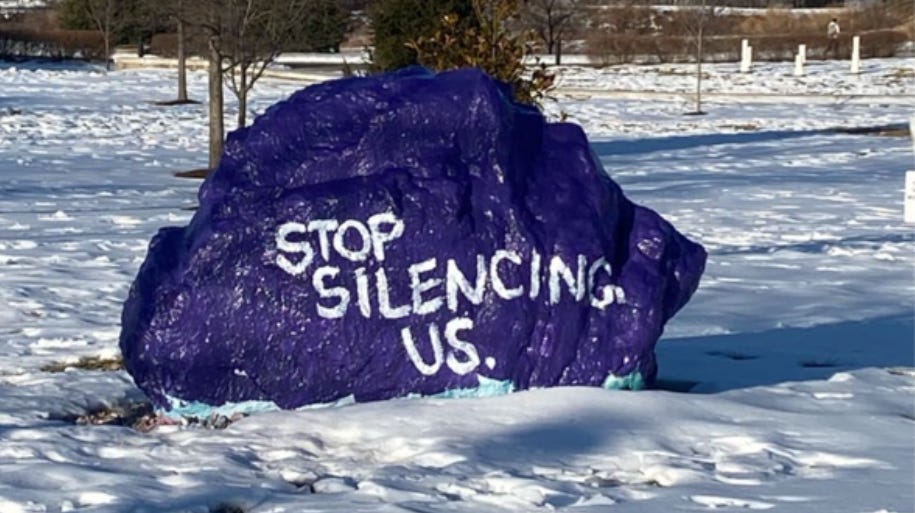
In a national study of college student views on free expression, the Knight Foundation and Ipsos (2024) found that only 43% reported feeling that their right to free speech is secure or very secure. This is down from 73% in 2016 – an exceedingly sharp decline in a short period of time. This comes as colleges and universities across the United States are confronting a wave of what free speech advocacy organization PEN America describes as “educational gag orders” or bills that target teaching and learning about issues such as race, racism, gender and American history. By 2025, more than half of all college students in the country were studying in a state with at least one law or policy that directly censors teaching and learning about public issues or chills campus speech by exerting political control over curricula or targeting shared governance and tenure protections.
Student organizing and campus protests have also been targeted. Over 500 colleges and universities saw student-led Pro-Palestinian protests during the 2023-24 academic year, which included about 130 encampments. The mostly peaceful protests were calling for a permanent ceasefire in Gaza, ending U.S. military aid to Israel and free speech protections for students and faculty speaking out on the issue. In the summer of 2024, colleges and universities across the country revised policies to curtail such activities to include restrictions on use of tents, changing acceptable times for protests activity, limiting student assembly to designated areas, governing the use of chalk on campus spaces and placing new restrictions on sound amplification. The American Association of University Professors expressed concerns over such policy changes by characterizing them as overly restrictive, noting that colleges and universities should be encouraging open discourse on public issues of the day.
Despite these growing challenges to speech on campus, national organizations have expressed their shared commitment to making civic inquiry and democratic engagement central to the undergraduate experience. About 70 higher education organizations, led by the American Association of Colleges and Universities (AAC&U) and Campus Compact, have called on colleges and universities to double down on commitments to civic engagement and provided a framework emphasizing the development of skills to address public issues through courses and practical experiences.
We observe that attacks on campus free speech, whether originating from elected bodies or campus administrators themselves, seem to conflict with efforts to promote civic engagement on college campuses. Policies on our own campus followed national trends after the 2023-24 academic year and were revised to tightly govern free expression on our campus (e.g., Policy 1121: Public Expression on Campus and Policy 3104: Bulletin Board Use and Posting Public Notices) and there was seemingly little activity in public spaces on campus leading up to the 2024 Elections. We, therefore, developed a study to consider questions we had about free speech on campus and whether it impacts student civic engagement.
Our Study
In our study (with Kayla Dixon), Fulfilling Higher Education’s Responsibility to Students and Democracy in a Challenging Political Environment, we sought to understand what students know about speech on campus, their attitudes toward violations of free speech by university administrators and whether they think free speech is protected in the current political climate. Further, we explored whether students are participating in democracy in the first place, and if their levels of engagement are connected to their knowledge, perceptions and attitudes about free speech.
In the Fall 2024 semester, 1,530 undergraduate students at a large public university completed a short survey that positioned us to explore these research areas. Respondents were provided with 14 scenarios describing hypothetical actions taken by college administrators in response to behaviors in the college community. For instance, in one hypothetical scenario, university administrators remove political signs from a wall inside of a student’s dorm room (a violation of First Amendment rights). For each scenario, students responded to three questions:
To measure free speech knowledge, students were asked whether the administrator violated First Amendment rights and given the choices of yes, no, or not sure.
To measure perceptions of free speech on campus, students were asked to evaluate the likelihood that university administrators would take the action described in the scenario and given four choices ranging from very likely to very unlikely.
To measure free speech attitudes, students were asked whether university administrators should be able to engage in the action described in the scenario and given choices of yes or no.
Our results show that students correctly identified 65% of the actions in the hypothetical scenarios as violations or not violations of free speech rights. This indicates that the typical student in our sample has moderate free speech knowledge. Students were especially prone to misclassifying scenarios involving hateful but non-threatening expression. In these cases, they often interpreted hypothetical administrative restrictions as permissible, despite the fact that the speech in question, although offensive, remains protected under the First Amendment. For instance, only 33% of students correctly identified the following as a violation: “prohibiting students from distributing pro-hate group materials near campus.” While some may contend that hate speech is not protected, this scenario and others included in the survey did not include unprotected speech such as true threats or incitement of imminent illegal activity.
Scores on the free speech perceptions measure indicated that, on average, students thought that administrators were somewhat unlikely to take actions that would violate free speech rights. Finally, the vast majority of students believe that university administrators should not be able to violate free speech rights as described in the scenarios they were presented.
Students were also asked questions in our survey to address the extent of their civic engagement. Three areas of civic engagement were included:
Cognitive engagement, including whether students made efforts to stay informed and discuss political issues
Public voice, including contacting public officials, protesting and signing petitions
Political activity, including volunteering for a political campaign, donating money to a candidate and displaying campaign paraphernalia
We found that students in our sample were not very active across the three areas. On average, respondents reported staying informed and discussing politics at least once a month. The most common score for public voice and political activity measures indicated that the average student had never engaged in the activities. Finally, we ran correlations between our three free speech measures (i.e., knowledge, perceptions and attitudes) and three civic engagement measures (i.e., cognitive engagement, public voice and political activity) and generally found that the two are not meaningfully related. Free speech knowledge, perceptions and attitudes, based on the students in our sample, were essentially independent of their engagement in our democracy.
What’s Next?
First, the good news. Students seem to understand free speech (at least to some extent). They generally have a sense of what it looks like on campus, they care about it, and they value it highly. Even more encouraging, most students trust that university administrators will respect free speech rights.
But there are some important nuances. While students value free speech, their understanding of it isn’t as deep as it could be. In our survey, there were only two response options (yes or no) for the free speech knowledge questions with one being correct. A student could get half of the items right simply by guessing, even if they have no understanding of free speech. Future research should consider other ways to assess knowledge of free speech, perhaps through interviews or survey items with more than two choices.
And when it comes to political engagement, most students in our sample aren’t very active. This is especially concerning given that students completed our survey in the months leading up to a presidential election. Interestingly, whether students are politically active or not doesn’t seem to be related to what they know, think, or feel about free speech.
The takeaway is a mixed picture. It’s great that students care about free speech and trust their institutions, but there’s also room to grow. Ideally, students would develop a stronger, more informed understanding of how free speech actually works on campus and become more actively engaged in the broader political issues, especially as they reach the legal age to vote in elections.
That said, it is important to ask: how representative are these findings?
Our study gives us a useful snapshot, but it comes with limitations. For example, 84% of our participants were in their first year of college. This wasn’t planned, it was a function of how students were recruited. That means we primarily heard from students who were just beginning their college experience.
And that raises some questions:
Do students learn more about free speech as they move through college?
Do their attitudes and perceptions change after a few years of real campus experiences?
Does political engagement increase as students progress through college, and does that influence how they understand and value free speech?
Another interesting point: students generally didn’t think administrators would violate free speech, and they said they’d be critical if that were to happen. But these responses were based on hypothetical scenarios. Most students in this sample simply haven’t been on campus long enough to encounter real-world tensions between free speech and other priorities.
Timing matters, too. Our data were collected in the fall of 2024 and reflect just one moment, and conversations around free speech are constantly evolving. To truly understand what students think and experience, we need research that keeps up with those changes.
Finally, future studies on the relationship between free speech and civic engagement should consider focusing on faculty, as the responsibility to advance civic learning and democratic engagement falls on them. An extensive report from the AAC&U found that faculty have become more careful when revising curricula to avoid controversial topics and that over half are more worried about being the target of online harassment than they used to be. If faculty are avoiding exploration of certain topics in their courses, research should uncover how that could affect students’ engagement with public issues and engagement with our democracy.
The upshot
Ultimately, we are inspired by calls to promote civic engagement on university campuses and disturbed by the seemingly unrelenting attacks on free expression. While this piece offers an exploratory look at the relationship between the two, along with pathways for future research, we suggest that practitioners focused on promoting nonpartisan voter education and engagement account for campus policies on free speech. The landscape is quickly changing and the grounds are unsteady. However, now is the time for creativity and a willingness to not over-comply. We witnessed this first-hand on our campus when a student developed expertise on the revised speech policies and implemented a student-facing nonpartisan voter engagement project one week before the 2024 election. Students, faculty and partners in the Students Learn Students Vote coalition can leverage the network to share ideas and encouragement to promote democratic engagement in the face of attacks on free speech. After all, doing so is an excellent way to support higher education’s civic mission.
 | A guest post by
|
 | A guest post by
|