What the Students Learn Students Vote Coalition’s 2026 goals tell us about the state - and future - of the student vote
The SLSV Coalition’s 10th anniversary marks an inflection point in the movement for 100% student voter participation.
On the evening of November 13 at the 2025 National Student Vote Summit, the Students Learn Students Vote (SLSV) Coalition celebrated its 10th anniversary with a retrospective exploring SLSV’s growth from humble origins to one of the largest nonpartisan pro-democracy networks currently active in the US. The story at the heart of the celebration was both uplifting and instructive for the Summit’s more than 300 attendees, who had just hours before sat down to discuss the SLSV Coalition’s next daunting challenge: Year 11.
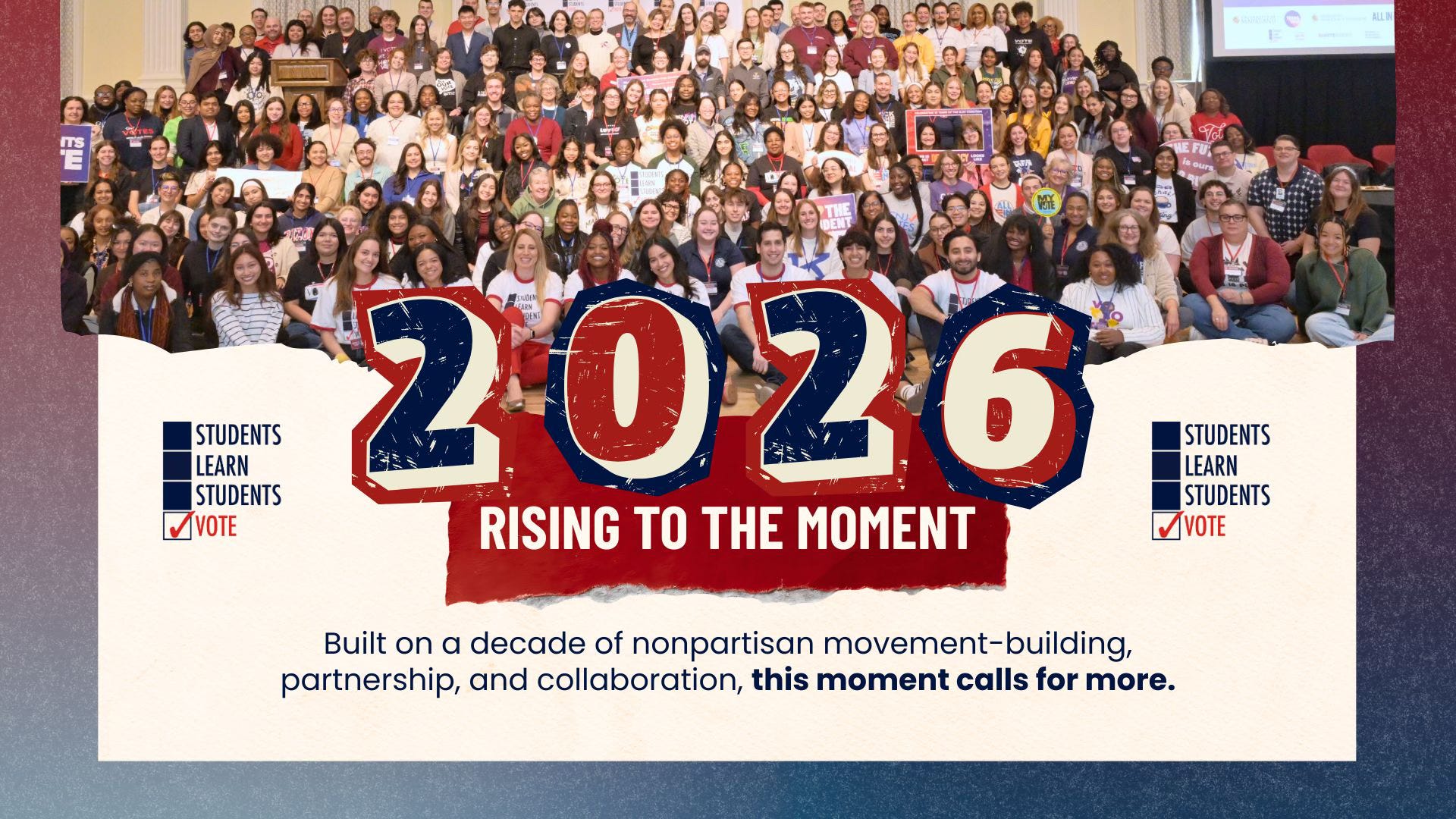
As they do every fall, 2025 Summit attendees took part in an interactive goal-setting discussion and activity that generated the basis of the SLSV Coalition’s agenda for the coming year. The resulting goals serve as both a statement of intent by the largest nonpartisan network in the US dedicated to growing college student voter participation, and an instructive snapshot of the state of the movement for 100% student voter participation. (For an informative snapshot of the nonpartisan student vote movement in 2025, check out the SLSV Coalition 2025 Annual Report here).
Here are some key takeaways from the SLSV Coalition’s 2026 agenda:
The state of the student vote is inextricably linked to the state of college students’ well-being.
The SLSV Coalition’s 2026 goals include the Coalition’s first-ever explicit plans to integrate a basic needs lens into nonpartisan student voter engagement work. According to Tufts University’s Center for Information & Research on Civic Learning and Engagement (CIRCLE), 43% of young people say they sometimes or often have trouble making ends meet financially, while various other pieces of research cite widespread lack of community among the same demographic.
These issues don’t fall within the traditional purview of voter engagement, but CIRCLE’s research, as well as significant anecdotal evidence and feedback provided by SLSV partners, link students’ access to basic necessities with a stronger likelihood to vote. Beyond any causal relationship, this new prioritization is a recognition that basic needs are front-of-mind for much of the student voting population, and need to be accounted as part of any effective and credible outreach strategy.
In a volatile environment, resilience and institutionalization go hand-in-hand.
In 2025 SLSV Coalition partners across the country encountered new circumstances that either changed or diminished traditional institutional supports, from funding to administrative backing to legal and regulatory changes that impacted how they could target students of different backgrounds and identities with nonpartisan outreach. This volatility highlighted the need for stronger and more widespread backing at the institutional level, a priority reflected in several 2026 SLSV goals.
Whether by “providing guidance on building campus leadership support into our resources and programming opportunities,” promoting nonpartisan voting coalition-building strategies, or continuing to grow the practice of nonpartisan action planning, in 2026 the SLSV Coalition will work across multiple fronts to ensure campus partners have more allies to turn to and a broader diversity of resources available to them. The resulting growth in strategic capacity should guard against the unpredictable nature of today’s higher education landscape.
There is a real need - and opportunity - for community building to advance the movement for 100% student voter participation.
In 2025 the SLSV Coalition made a concerted effort to foster community among its partners. Monthly Coalition meetings were re-formatted to include time for peer-to-peer dialogues, and programming at the National Student Vote Summit sought to build positive relationships across the Coalition between stakeholders who otherwise might not have had the opportunity to meet.
These efforts were met with broadly positive responses that, when coupled with CIRCLE research indicating a need and desire for more community interaction among young people, give the SLSV Coalition ample reason to double down on its emphasis on community in 2026. Goals to “coordinate and facilitate programming… that intentionally cultivates community learning spaces…” and “assess the landscape of existing spaces for shared learning, collaboration, and connection” show that SLSV continues to see building community as a central priority. As the National Student Vote Summit - whose success is another 2026 goal - continues to grow in size and import, SLSV gatherings and community spaces could also help position the Coalition as a nonpartisan political home for student voters at a time when that is increasingly needed.
Student vote leaders believe in campus and local media, and want to work with them to spotlight successes.
Two common themes of partner feedback during the National Student Vote Summit were a desire to see more student-centered success stories about nonpartisan voter engagement, and an interest in building stronger relationships with campus-based media organizations. While campus-based outlets have long held a prominent role in broader SLSV media strategies, the palpable desire to tell stories that resonate within campus communities led the Coalition to explicitly center these publications in its 2026 goals more than in any previous year.Following 2025’s coalition-wide focus of relating local voting issues to students’ day-to-day experiences, this 2026 goal indicates a strong resonance of local-level storytelling that continues despite the looming presence of federal elections this fall.
Community colleges and nonpartisan student voter engagement positions represent two major areas for potential student vote research.
The SLSV Coalition’s 2026 agenda features two goals aimed explicitly at building knowledge in areas where research has lagged compared to other areas relevant to the movement for 100% student voter participation: nonpartisan student voter engagement at community colleges, and the educational value and learning outcomes of student positions dedicated to engaging fellow student voters.
Gains in knowledge in either area could point future SLSV Coalition programming in new and exciting directions - and help generate great content for the State of the Student Vote Substack.